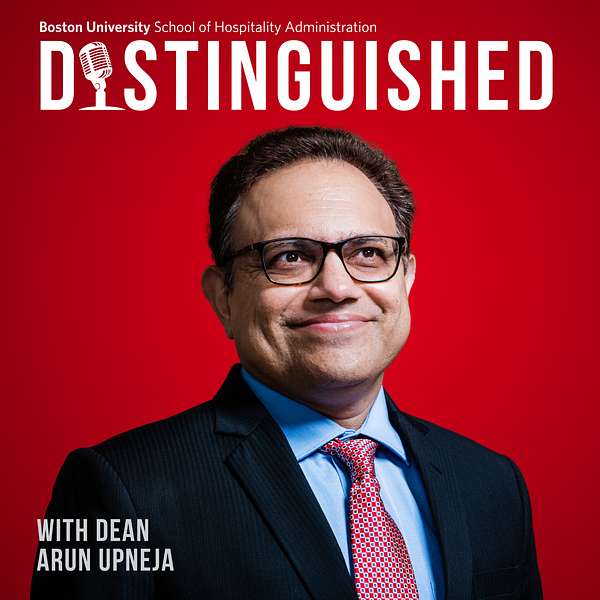
Distinguished
Welcome to the Distinguished podcast with Dean Arun Upneja of Boston University School of Hospitality Administration.
We skip the small talk and get right into the top-of-mind topics in the world of hospitality, including, but certainly not limited to, inflation, recruiting and retaining talent, the wellness and wellbeing of our team and our guests, climate action, and the impact of robotics and AI on the future of Hospitality. And that’s just to name a few.
On this show, you’ll hear from executives, general managers, founders, and investors who live and breathe Hospitality. The “distinguished” guests on this podcast represent all areas of our industry, from hotels and restaurants to entertainment and sporting venues, travel and tourism, and of course, a favorite pastime for many of us —shopping — because, to put it simply, Hospitality is at play in most parts of our lives and livelihoods.
Distinguished
Inhospitable? Redefining Service in Luxury Hospitality with Kate Buhler, Founder and President of Profitable to Train
Kate Buhler, founder and president of Profitable to Train, is a leading expert in hospitality service excellence and profitability. With decades of experience across luxury brands including Four Seasons, Ritz-Carlton, Rosewood Hotels & Resorts, Baccarat, Peninsula, and Bulgari, Kate is known for her unique approach to training that drives both employee satisfaction and financial success. Her new book, Inhospitable: Lessons Learned from a Lifetime in Service, tackles a critical question in the industry: why is great service often so hard to come by?
In this episode, Dean Arun Upneja engages in a thought-provoking conversation with Kate about the evolving landscape of hospitality, the critical role of the human touch in a tech-driven world, and how her “Profitable to Train” method helps businesses unlock untapped potential. Kate also shares insights on bridging generational gaps in service expectations, strategies for meaningful revenue management, and advice for rising professionals.
The “Distinguished” podcast is produced by Boston University School of Hospitality Administration.
Host: Arun Upneja, Dean
Producer: Mara Littman, Executive Director of Strategic Operations and Corporate Relations
Marketing: Rachel Hamlin, Senior Marketing Manager
Research: Lu Lan
Music: “Airport Lounge" Kevin MacLeod (incompetech.com)
Licensed under Creative Commons: By Attribution 4.0 License
http://creativecommons.org/licenses/by/4.0
Arun: Kate Buhler is the founder and president of Profitable to Train. I'm excited to have Kate here because she not only brings a wealth of knowledge but also a refreshing perspective on hospitality. She's worked with major luxury brands such as The Four Seasons, Ritz Carlton Rosewood hotels and resorts, Baccarat, Peninsula, and Bulgari, in addition to exclusive independent properties, Kate's specialty is finding ways to increase both job satisfaction and company profitability. In her newly published book, which I have right here with me “Inhospitable: Lessons Learned from a Lifetime in Service," Kate explores the commonly asked question why is good service so difficult to find? I'm Arup, Major Dean of the BU School of Hospitality and host of the Distinguished Podcast. Welcome, Kate, and thank you for joining us.
Kate: It is wonderful to be here. Thank you so much.
Arun: OK, so let's talk about your new book “Inhospitable”. Well, first of all, congratulations. The title really grabs you. So, what inspired you to write this, and what do you hope leaders will take away from?
Kate: Well, I've been talking about doing it for a really long time and I'm glad I finally, especially during COVID, had time to put pen to paper, but it's really I tell the story of what the hotel industry used to be like what it's evolving into and what I hope that our beloved industry will become in the future. There are so many changes happening. I sort of wanted to mark them down and allow other people to have a discussion about it.
Arun: So, you write about how ideas and expectations of service and hospitality have evolved over time. What do you think we have lost in this evolution and what do you think we've gained?
Kate: Well, you know, overall, especially for mid-priced hotels, it's clear that things have become more casual, in this texting world, people are speaking in shorthand, and everything has to be super-fast. But in the luxury market and in lifestyle brands, I've noticed that young people are technically waiting on people that are one to two generations older than they are, so they need to be able to communicate with people from a different generation who have different expectations. And the other thing that I've noticed, which is kind of fun, is that influencers on the Internet. Now we are talking about getting dressed up and going out for special occasions, and I'm seeing more and more young people actually want to celebrate and want to get dressed up again and sort of enjoy some glamour again.
Arun: Then that's a good change because at some point, you know, I think over the last many, many years, there was this tendency to dress down and say why you need to dress up. I mean, even airplanes, you know, growing up, you had, you had to really dress very nicely and then over time, now we just go in our whatever we happen to be wearing.
Kate: Pajamas, right
Arun: So, you talked about the young people serving people who are generations of a couple of generations above them. So, let's dive right into the expectations of service and the trends that we see emerging in luxury hospitality space. Given that you've worked with the leading. Brands Peninsula Four Seasons, Ritz Carlton and many others. So, what kind of trends have you seen?
Kate: Absolutely in the highest levels of luxury, I'm seeing companies trying to develop their brands into lifestyles so you can purchase branded products from some of the luxury hotels. And this was something they always did a little bit on the side. But now it's really their chance to get their label out there when people are not on vacation. And as conversation pieces. So, I'm seeing that happen. I'm also seeing different companies trying to basically make their mark as special unique in the industry, and that's especially hard to do right now because there is huge competition for the top. There are so many new brands that are developing that have developed in the last five years. And they're creating a lot of competition, I'll say. Also, I'm noticing that in Euro and in Asia and the Middle East, so really every region except for the Americas, I'm s seeing really an old-fashioned competition in who can provide the most pampering, most luxurious service and of course, the US is a little bit different from that.
Arun: The labor cost is here so high that it's just very difficult to provide that level of service in in the United States. So, I was recently in Cairo and Egypt. And I'm speaking to the general manager of a luxury hotel there, he said. My cost of service and you know, you'll be shocked. You may not be shocked, but a lot of people in the US would be. He said it's about 15%.
Kate: Yes. And so in in the Middle East or if I met a client in Asia, we talked a lot about Butler service. We're talking about elevator operators, pages, things that have kind of gone by the wayside here in the US, for sure.
Arun: So, with the high cost of Labor, now we are seeing a lot of automation. We're seeing a lot of AI, so rapid rise in technology. So how do you see the future of luxury evolving? Particularly in the United States, where the cost of Labor is so high. Are there aspects of the human touch that technology cannot replace?
Kate: Absolutely, here's the part where I get a bit concerned, you know, especially in the US, starting with technology, first of all, I'm an older person. I like to say older, not old. But I remember when the fax machine was really exciting and back as we were watching technology get developed. In the hospitality industry, we all thought it would mean actually less work for us and boy were we wrong. What has it done instead of giving us more time to be creative? And really to serve the guests more. Employees are expected to take on ever more responsibilities and positions are merging together. I think that's the biggest concern I have right now for the future of this industry is that if you continue to merge all the departments together, something gets lost. AI is still finding its place in the hospitality industry. What I've seen is, you know, if a company wants to send out a generated reservation message, or if there's a welcome bot text coming in for a convention hotel. I think that's fine, but there's no feeling of personalization. So, the things that can't get replaced, I think housekeeping, engineering, spa service, really good food and beverage servers, and in my opinion, a great concierge still can't get replaced by technology, even though I know a lot of people will try.
Arun: Right. And interestingly, if you have a small hotel on the smaller side, if you have a hotel, you know 3-4 hundred rooms or bigger, you can afford to have concierge and you can afford to have food and beverage and spa. But if you are on the smaller end, it's very hard to justify keeping a concierge or having spa operations when you cannot justify, you know the kind of. But the larger the hotel than the concept of luxury falls apart. So, we're in this very strange world where it's very difficult to get everything right in terms of scale versus the injury and personal touch.
Kate: 100% earned. So I think you've actually touched upon the most important factor that I think will keep this industry going strong and that is not to consider these things in luxury as amenities, but instead to consider them as the value for money that people are getting when they come to a full-service hotel. So, you are correct that in a very large hotel, it's hard to have luxury. But a single concierge, if they're really good at what they do and they're working, let's say in a small resort, they can bring over $1,000,000 worth of business. Ancillary business, spa appointments and tours to the area. So actually, they should be positioned to make the property money, as opposed to being an expense of a salary. But you're touching on something so crucial because people will say, I will tell, for example, a potential client. I have a great idea. This will make your property an extra $2,000,000 a year and you just need to hire an extra front desk agent, and they won't do it, and I think, well, that front desk agent is costing you $80,000. So, we have to be mindful of spending some money, investing some money in order to be able to make money too.
Arun: Going to spend money to make money, right?
Kate: That's the truth.
Arun: So, in terms of technology, one of the questions for you, which is that you have two equivalent hotels, both 150 rooms and one is ultra luxury charging, you know thousands of dollars a day and the other one is you know $200-300.00 range. But the cheaper hotel at 300 is not cheap, but lower priced hotels have robots that are going and delivering to the room. going and delivering to the room. So, you check in at 2:00 in the morning, you go to the go to the room, and you need something. The luxury hotels as well, we can send robots to the room. And so, they have to now wait for a human being to get free from some other duties, to go up to the room. And it might take, you know, 20 Minutes. Thirty minutes. Where the low-price hotel just puts the toothbrush on the robot and presses the button and it goes and delivers. So now you have a cheaper hotel delivering faster service than a luxury hotel, and at that point. Do I want a human touch? Somebody delivering to me or do I want it quick and right there? And to me that is the luxury of time.
Kate: Right, right. So, I love that example, and you know, to me, first of all, I would love the robot. That sounds great for delivering a toothbrush. I'll take a robot any day. For the more complex, I accidentally left my passport in an airplane in Morocco. There I really want a person to help me. I want somebody who, first of all, will answer the phone when I dial 0. And then I want somebody who knows someone who works at the airport to be able to get my passport back. So, there I'll pay a lot of money for that human touch. I think that where we could use technology would be in the mundane, but where we need to put really skilled, amazing hospitality workers are in the creative. So, we've kind of been doing it the opposite way around. So, I'm excited to see it go that way.
Arun: That's amazing. Threading the needle in terms of where automation and robotics can help versus real, but by the way, is that story real? That you forgot your passport.
Kate: It is actually. It was really stupid but sure enough, the concierge was able to have the passport and a little chocolate waiting for me in my guest room. And while I was speaking, he signaled to me from the back of the room that it was all taken care of. So those are the things right that you just can't replace.
Arun: We all need to live in hotels where we can use these concierges.
Kate: We do.
Arun: OK. So, let's shift gears a little bit now you develop this method, the profitable to train, which sounds like a fascinating approach to both service and profitability. So, can you walk us through the core of this method and how it impacts the businesses you work with?
Kate: Absolutely. It's taken me 35 years in this industry, and it's taken me at least 25 to fully develop this concept. But the premise is simple. I make sure that the employees and the managers all know what the final goal of ownership is and when everybody understands what the game plan is, they're going to do it. So, I'll walk you through a typical client. So typically I will arrive at a property I'm going to a property in Los Angeles on a couple days and I'm going to experience the product as a customer and I'm not just going to look to see if they hit industry standards, although I will, but I'll also look to see do they sell to me. Are they responsive? Are they kind? Then the next step after I've looked at it from the point of view of a customer as I analyze their data. So, I think about it from an ownership point of view is every department as profitable as it could be. And I don't just look at saving money because no one ever got rich saving money I look at are they selling? And I look at what is selling. I even look at who is selling one server in a restaurant could be selling anywhere from a half a million to $1,000,000 a year worth of stake in a steakhouse for example. Sometimes I'll see 2 servers. They both work the exact same shifts, 1 selling 500,000 and one selling a million. Well, I want to know why one person is doing twice as much. So, I look pretty deep into the layers of how they are making their money and what's working. And then, I've looked at it from the guest point of view, from the owner's point of view, I look at it with the employees and we do a workshop where we talk about sales techniques. We talk about strategy, and I show them their own numbers, usually for the first time. When an employee realizes how valuable they are to their own company. They make much better choices in the future. When they truly understand how a small change can completely impact their bottom line and their take-home pay, they make much better choices in the future. So, then I finally take all those 3 aspects and bring it to leadership and management. I share with them the employees who told me what they need to be successful. And we make sure that everybody's on the same page. It really works wonderfully.
Arun: Do you ever have the situation where the employee says I am that valuable? I'm going to ask for extra money.
Kate: I have. I've had them say I want to get a promotion, or I've had them say I feel like I should be better compensated. And I say well, then let's look at that. Why do you think you aren't?
Or if you want to get a great promotion, your attitude is going to go a long way towards that also. And there are many people that I trained as waiters and front desk agents. That are now general managers that hire me, so I love that actually.
Arun: Fantastic. OK. So, you've mentioned the concept of a service generation gap. So, what does that term mean and how does that affect? How should hospitality teams be trained?
Kate: Absolutely. So, for the employees who want to work in the detail oriented competitive luxury market. I make sure that they understand the expectation of people who are a couple of generations ahead of them, like 20 to 40 years older than they are. There's a lot of exceptions, of course around there are wealthy people who are young, but for the most part, luxury hotels have a higher average median age than a business hotel, for example. So, we talk about the art of writing a thank you note, and we talk about when texting, using full sentences and I'll say, like your parents do when they get it. I will talk about personalized touches whenever possible and how I say to them, don't just touch a guest wallet, but also make sure you're touching their heart. I have a story for you. Actually, I will tell you. You know, years ago when I first started in the industry, I worked for a while as a Butler. And Butler's do a lot of different things. But one of the things we could do is open the guest suitcase. We would take Polaroid pictures of the suitcase, and we would do that so that when we unpacked and repacked for them at the end of their stay, it looked exactly the way it did when it came to. That is a typical example of how we can show value to our guest when we take the time to have that one extra special touch. Guests appreciate it and guests come back for generations.
Arun: I guess appreciated then I'm not sure now, will they appreciate it if you open their suitcases and take a detailed scan of everything that they have.
Kate: Understood. Well, they have to know in advance. We're going to do it. I certainly wouldn't do that without telling them first. But you know, you bring up a point, a lot of hoteliers are saying to me, oh, I don't think our guests even want us in the room. They want to just be left alone and I'm not sure that that's actually true. I think most people would love twice a day room serve twice a day housekeeping service and by the way, while I'm at it, they would love 24-hour room service. These are things that we're telling ourselves that the guests no longer want or we're offering to guests, but at an extra cost, which of course then they don't want. But if you want to justify that $1000 price tag. What are you giving them besides the room to sleep in? And honestly, I think there's nothing more lovely than going out with clients or going out with friends coming back pretty late at night and having your room made-up for evening service. So, you know, it saves money to cut these things, but it also might just cause them eventually to have to cut prices too.
Arun: Clearly you are not talking about me because I put a do not disturb sign on for the duration of my stay. If it is 2 days, three days is a do not disturb sign. I think I was in a hotel luxury property earlier this week and by mistake I didn't put it on, and I came back. The bed is all made-up room. Yes, it did feel good. But you know the note and the chocolate by the red side also made a difference.
Kate: Interesting. Interesting. I'm learning so much about you today. Do you love it when you come home, and everything is in beautiful, pristine condition?
Arun: OK, so my question is how can hotels continue to provide service and value to the guests? Not just on a pay-per-view basis, but more authentic hospitality. And you did mention hotels doing away with many of these services and then adding a lot of charges if you wanted.
Kate: Yes. So, as I said, you know, I worry about this race to the bottom where we've cut, cut, cut services, especially for good reason during COVID had to cut a lot of services but, housekeeping room service. Evening service to me, they differentiate a hotel from a short-term rental. And by the way, don't get me wrong, I love a good short-term rental. Sometimes there is a place for that in the market when I travel with my family. If it's going to be a longer stay, then I'm with you. I want to feel at home, but if I go to a full-service hotel, the best executive housekeepers in the world will say to me when I'm testing their hotel, they'll say I want to make sure that you can see that the housekeeper touched everything in the room. Whereas when you're in a non-luxury hotel, the rule of thumb is doesn’t touch the guest things. So, if you're in an economy hotel, you don't touch the guest things at all. If you're in a luxury hotel, you touch everything in that room and you do wherever possible a small personal touch so that the guest knows that you care. Examples if I have medication out near my nightstand, they automatically put a bottle of water next to it. If I went for a run and I have my sneakers out, they automatically tuck in the laces. So, these are tiny little things, but they're the things that make going to a hotel special.
Arun: And these are some practices that are employed by some very high-end hotels with daily room charge that would justify that kind of expense. So, you're hired by companies to increase profitability, and you mentioned that earlier, which comes down to revenue management. So, we think our revenue management mostly in terms of numbers, but do you think of it as more of a human equation? So can you expand on how people's emotions and guest experiences factor into your revenue strategies.
Kate: Absolutely. So, first of all, it doesn't matter how beautiful the building is. If the employees aren't kind and nice, I see no value in being there. So, everything is dictated by emotion. Most of the properties I work with, they want me to, for example, design their front desk upselling program. That's a specialty of mine. And a typical hotel will make an additional million to $3,000,000 a year with an upselling program just for those that aren't in rooms when somebody has. When a hotel has unsold suites, they will offer them to a checking and guest at a special price. Now, many directors of revenue think of that, and I was a director of revenue for quite some time. They think of that as an equation, and you calculate what the prices should be. And I do that. But actually, what you also have to do is you need to tell the agents what to say. What verbiage do you use? You need to explain the reasoning behind making an emotional luxury buying decision. They have to understand the psychology of a guest, and most of these guests are quite a bit wealthier than they are. We also need to tell them what to say when something goes terribly wrong, otherwise they won't say it again. So, all of those safeguards are to make the employee feel safe enough to ask someone for more money at check in, and when you have an employee who's comfortable with that, then they will execute and do a beautiful job on your pricing. But you have to have both.
Arun: Right. And you mentioned this the psychology behind and making the employees feel comfortable, I think that's one of the hallmarks of our school is that we think that we are in the business of human interactions and taking care of people and providing them with their experiences. But I want to go back to something that you said in the book. Which is that places of work are buildings. They're occupied by people, and you're working, so don't get too attached. But then at the same time you want the employees to be engaged and provide this amazing service which if they are not really identifying with the company that they work with so kind of thread the needle there, how do you reconcile those two kinds of thought processes you have?
Kate: Absolutely. I think I can do it best by telling a story. So, while I was working as a Butler again, this is the beginning of my career. I had a regular guest who was never happy. He was just never happy with my services. He yelled all the time. He was extremely difficult and one of the things that he would do every night was he would ask me to come to the room at 4:00 exactly, with a bowl of warm mixed nuts. And then he would say to me one day, “Kate, I don't want any cashews”. And I would have to go back and pick out all the cashews and then the next day he'd say, you know, I really don't feel like any almonds today. And I would have to go pick them all out. And it was so annoying, right? I was really mad. And I was in the back picking out whatever it was he told me to do. He did the same thing with M&M's on a different trip. And I finally realized that actually what he wanted was to feel powerful and important. So, I stopped kind of giving him a little attitude. I started to actually address him the way he wanted to be addressed and to give him the courtesy and the attention that he needed. And he was much nicer after that and much happier. The fact of the matter is I was annoyed by his odd ways, his odd behavior, but I learned not to take it personally. So, you, as a person who works in service in the service industry, have to always give a lot of warmth, a lot of caring. You should care about your guests. Whether they're nice people or not, that's not the point. But you should always protect the peace of your heart because the guest is not going to have that same feeling towards you.
The company companies change. They change heads, they change, they change ownership, they change even their methods. You have to stay true and figure out what is right for you.
Arun: One of your secret powers is teaching tangible, effective tactics for individual employees to increase sales, and you've been mentioning that throughout the conversation. So, beyond training, how do you get employees at all levels invested in the company's success and the bottom line?
Kate: Absolutely if you show an employee real number. How much money, for example, they made last year in tips, and then you say, OK, that was with an average check of $60. If you sold one extra item to a guest, an additional $20 appetizer, one additional $20 glass of wine. You would have made an additional $30,000 worth of tips. They will do it. So, when you can show them on paper exactly how the business works and how they will be more successful, then they definitely are invested. You also need to show them what the Medallia scores are, what are the customer satisfaction scores of their department, I usually like to start off first by saying what do you think it is? And they'll answer. And then I'll say, well, it's actually this number here. How could we get it to that higher number? And when you show them every single month what their number is and they see that number grows over time, they're getting invested emotionally in the success of the company. So, my favorite things to hear from employees that stay in touch with me is I make more money because of what I learned in our workshop, or I got a promotion after trying something. You taught me. This is actually the reason why I do what I do. But honestly, for me it's a joy to see employees start to take control and take charge of their own success. Financial and career success.
Arun: Yeah, when you started off at some point, I was thinking, OK, now how do you reconcile, you know, this generation of, you know, the millennials and the Gen. Xers and sometimes we feel that they don't even care, but you bring the economic argument that, OK, if you care and if you do what you're supposed to do, you're going to be making so much more money.
Kate: That's right, you have to bring it back to them.
Arun: OK, so looking back at the wealth of experience that you've accumulated in the past 35 years, what have you loved the most about working in hospitality?
Kate: Well, so again, we've been talking about it, but hands down, I have loved meeting the people who work in hospitality hearing their stories and getting to see them just grow their career over time. So, I've worked with a lot of famous celebrities and the glamour of that is a lot of fun. But actually, that's nowhere near as interesting as seeing somebody come to a new country, start their lives over again and sacrifice everything that they have. So that their families can have a better life. To me, there's no greater joy than that. And then, of course, I also just really love a well-executed service. So, if there's a, if there's a beautiful restaurant or an amazing experience that makes my heart sing too.
Arun: What's your number one lesson? What advice would you give to aspiring hospitality professionals such as the one graduating from Moscow?
Kate: Absolutely. You know, I have so much faith in this business, and I first want to congratulate them on making a great career choice because it's an adventure. But my biggest advice is probably the one thing they don't want to take and that is I say take your time and learn the business, and don't be afraid to take an entry level job in the beginning if you want to manage waiters, many of whom are 30 years older than you are, you better know how to be a great waiter. And if you want to be in sales, start working as a catering assistant and learn how a wedding actually grows from the beginning to the end of a contract. And here's where a lot of students will say, well, then, why did I go to school? Right? College is expensive and I am very well aware of that. I just paid for my two sons' colleges. But I will say that your college degree will help you move faster through the ranks, and there will come a time when that will be really important that you have that degree. But in the beginning, you can't make a mistake. Just take any job and Start learning from there.
Arun: Right. And one of the things we do, we require 2 internships here at our school for undergraduate students, and each internship has to be at least 300 hours. And I always tell students the first internship that you're doing has to be line level. You cannot try to get into a management position. You need to learn how to work with people that you'll be managing very soon.
Kate: Absolutely. That's so valuable because I've seen a lot of potentially great managers burn out. Because they never really learned or understood the job that they're managing. And then of course, they're not going to be successful.
Arun: So let's we have a lightning round of questions, but before that, I think I want to mention one thing that I learned about you when we met last time, which is that you are in Boston one week a month and the other three weeks you're travelling each week to a different luxury property. Sometimes resorts. Sometimes cities like Los Angeles. You're going to San Francisco and other beautiful cities of the world. That's incredible. You made it.
Kate: Thank you. Thanks very much. It is the joy of my life to travel and to be in one company in London one week and be in another company in Los Angeles the next week is really how you get that broad spectrum of what's happening in the industry, so I feel very blessed. Very lucky.
Arun: Do you get tired of travelling?
Kate: I really don't know. As soon as I am tired of it, I'll stop. But first, I'm staying in beautiful hotels. So, remember, I'm spoiled, but also the fun of it. The fun of seeing going to a property and then coming back a few months later and seeing what they did with the information also keeps it going and keeps it interesting.
Arun: OK, so what's your favorite creature comfort when you're on the road?
Kate: Yes. I love a really light, airy, crisp duvet. That's not just my favorite thing in the world, it is just being jet lagged, getting into bed and that will make me happy.
Arun: And what's the best splurge when you're travelling?
Kate: I'll say business class, business class in the airplane, one of my favorite tricks is to buy an economy ticket and then when you go to the airport, always be well dressed. Go to the first-class section and say: How much would it be for a business class upgrade and it's usually 50 to 80% off the full price. Also, a great massage is something I like to do.
Arun: I would have imagined that with so much flying, you would have had statuses and, and you know a lot of miles to upgrade from.
Kate: I have some great points. I save them for when I'm traveling privately.
Arun: What is the strangest request you've ever gotten in your years of working in hospitality?
Kate: Besides having to pick out certain nuts, I will say there's plenty of requests that I can't tell you on the air, but I will say we once had a prima ballerina stay in a very large presidential suite and she requested pillows to be placed covering the entire floor. And it was about 2000 square foot space. So, we had to fluff the pillows every day and put them down and back out of the room so we wouldn't have our own footprints.
Arun: Wow. Why did she want that? Was she dancing on the below?
Kate: Her poor little feet must have looked terrible. I didn't ask.
Arun: What is the most inhospitable word or expression?
Kate: Oh, that's easy. No. Or uh, no. Sorry. Right, that's flat. No, sorry, we don't do that. Going back to your example about, you know, a robot bringing a toothbrush up at 2:00 in the morning. I think unfortunately what's more likely to happen is you call down for a toothbrush. And they say no, we don't have that, sorry. And they don't even bother to bring it up. And so that just drives me crazy. You know, it's not that we never say no to a guest, as long as it's legal, moral impossible, we find an alternative.
Arun: I hope you don't encounter that too much, since luxury properties you're staying in.
Kate: You would be surprised. You'd be surprised at, you know, when there's no staffing, right, for example.
Arun: Most hospitable word or expression.
Kate: Also, an easy one, and it's also a great trick when wanting to defuse an angry guest. The best phrase you can use is thank you and for. For example, if a guest is angry with you, I teach in my workshops to say thank you for letting me know. Thank you so much for the information.
I really appreciate you telling me that here's what I'm going to do about it. Thank you for choosing us. Thank you for staying with us. Thank you for bringing your children here. Anytime you say thank you, it triggers a happier emotion, and it slows the guests down. But when you say thank you for letting me know, it's so much better than I wasn't aware that was a problem, and it's how you get somebody on your side.
Arun: Right. And I think one of the phrases you mentioned and here is what I'm going to do about it. That's my pet. And that makes me very happy. If there's a problem, I point it out and someone says: OK, and this is what I'm going to do about it. Otherwise, many times they just say, OK, thanks for letting me know. And then promptly forget about it the moment you've done you.
Kate: It's true, absolutely. You have to follow up.
Arun: Thank you for joining us and giving us all of these insights about travel. I think after listening to the podcast, there might be many people who might want to work with you and be your assistance while you're travelling. So, thank you so much.
Kate: Thank you very much. Thanks for the opportunity and thanks for all the work you do.
Arun: And thank you everyone for joining us today.
