Distinguished
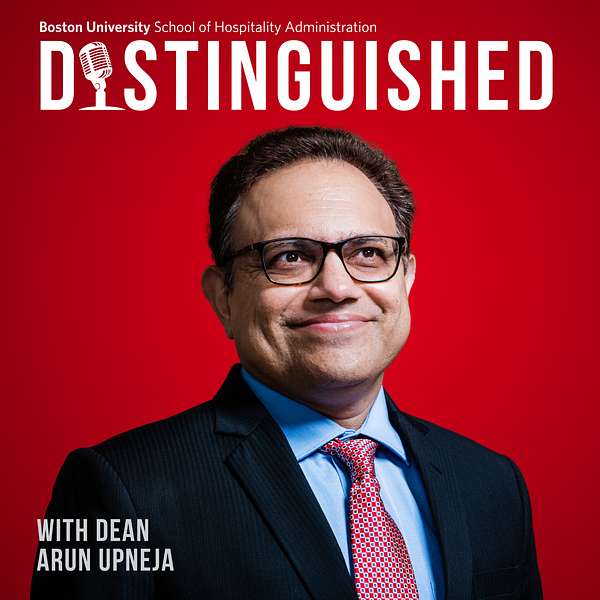
Welcome to the Distinguished podcast with Dean Arun Upneja of Boston University School of Hospitality Administration.
We skip the small talk and get right into the top-of-mind topics in the world of hospitality, including, but certainly not limited to, inflation, recruiting and retaining talent, the wellness and wellbeing of our team and our guests, climate action, and the impact of robotics and AI on the future of Hospitality. And that’s just to name a few.
On this show, you’ll hear from executives, general managers, founders, and investors who live and breathe Hospitality. The “distinguished” guests on this podcast represent all areas of our industry, from hotels and restaurants to entertainment and sporting venues, travel and tourism, and of course, a favorite pastime for many of us —shopping — because, to put it simply, Hospitality is at play in most parts of our lives and livelihoods.
Distinguished
Tipping & Wages Series: Politics Play Up the Benefits of Eliminating Taxes on Tips
Kamala Harris and Donald Trump both have proposed eliminating taxes on tips for service workers. While seemingly beneficial, it might just not add up according to renowned economics expert Larry Kotlikoff.
Named one of the world’s 25 most influential economists by The Economist Magazine, Kotlikoff has advised the Federal Reserve, the International Monetary Fund, the World Bank, and various other prestigious organizations. He is also a Professor of Economics at Boston University, with expertise spanning personal finance, inequality, taxation, Social Security, climate change, investing, healthcare, deficits, and insurance.
The “Distinguished” podcast is produced by Boston University School of Hospitality Administration.
Host: Arun Upneja, Dean
Producer: Mara Littman, Executive Director of Strategic Operations and Corporate Relations
Marketing: Rachel Hamlin, Senior Marketing Manager
Research: Lu Lan
Music: “Airport Lounge" Kevin MacLeod (incompetech.com)
Licensed under Creative Commons: By Attribution 4.0 License
http://creativecommons.org/licenses/by/4.0
Arun: It is seldom that major party presidential candidates agree on any issue. However, in this election cycle, there is an issue on which they both agree, both have come out in favor of eliminating all taxes on tips for service workers. While this might seem like a benefit for service and hospitality workers, it is worth exploring what kind of impact it will have. To provide clarity on this issue, we are joined today by Larry Kotlikoff, a renowned economics expert. Named one of the world's 25 most influential economists by The Economist Magazine, Kotlikoff has advised the Federal Reserve, the International Monetary Fund, the World Bank, and various other prestigious organizations. He is also a professor of economics at Boston University. I'm Arun Upneja, Dean of the BU School of Hospitality, and I would like to extend a warm welcome to Larry on the Distinguished podcast.
Larry: Arun, it's great to be with you. Thanks for having me.
Arun: Before we dive in, I just want to make it clear that our focus today is on money and policy, not politics. So Larry, help us understand this proposal from both presidential candidates to eliminate taxes on tips for service and hospitality workers.
Larry: I've got to tell you; this is one of the stupidest proposals I've ever heard advanced in a long career. So the only thing this is going to do is dramatically hurt hospitality workers who are receiving tips. Here's the reason. Most of these people are not earning enough money to be paying federal income taxes. So what we're talking about here is eliminating FICA taxes, social security taxes. But the way the FICA, the social security system works is that it's highly progressive. So these contributions that you make when you're a waiter or bus person or a cook in the back or a pot washer, well, whatever it is that you're doing in hospitality, but the ones who are getting out there or interacting with the public and getting tips, so they're not going to be making FICA contributions. So therefore, they're not going to be getting future social security benefits to the extent they would otherwise be getting. And the way the system works is that for every dollar, a low-wage worker contributes to social security, they get back in present value far more than a dollar because the system is highly progressive, as I mentioned. So this is going to, on a lifetime basis, cost service workers who are getting, receiving tips a lot of money. And it's also going to kind of spread the word to people who are working as service workers in other occupations where tips are not a general thing, like a contractor or a plumber, that not paying taxes on money they receive is okay because the waiter in every restaurant I go to doesn't have to pay taxes. So why should I? So it's okay if I ask to get paid in cash. And now, all these other low wage, basically low earning workers will be not making FICA contributions. And again, they might save some money on their federal income taxes, but it won't be really enough to make up for the loss of future social security benefits. So I think this is really first order stupid. And the fact that both candidates are supporting it is testimony to how bad our, you know, their economic advisors are, that they don't actually explain to them what really they're recommending. I mean, we have countries in Latin America who are in terrible trouble for decades, not just Latin America and Africa and all the emerging countries of the world, even in Russia, where the underground economy, the informal sector, as they call it, is massive. And they don't, can't collect enough revenue from these people to provide decent schooling and water supplies and public goods of all kinds, highways. And they're doing everything they can to get everybody into the formal sector. And here we have the two presidential candidates promoting the informal sector. It's crazy.
Arun: Okay, Larry, so very provocative thoughts. But let's unpack this one by one. And I want to make sure that people listening understand what you mean when, at the beginning, when you started talking about not paying federal taxes. So there is this concept of standard reduction, which, you know, has really increased over the last few years. And then there are personal exemptions. So are you suggesting that a big proportion of service workers are being covered under the federal, the standard deduction and personal exemptions? So they're not paying federal taxes. So at the end of the day, they are paying only the 6.2% FICA, since Medicare, everyone has to pay. So they are only saving 6.2% from the FHA.
Larry: Well, that's close to what I'm saying. But the total tax is 12.4%, which is the employer plus the employee shares of FICA. Now, no economist worth his salt or her salt thinks that the employer paid share of the FICA tax is actually being paid by the employer. If I am working for you and Uncle Sam says, Arun, you have to pay $300 a week for an extra tax for Larry, you're just going to cut my wages by $300. So because you're not, or you'll fire me and hire somebody else that you don't have to pay that tax on. So the point is that employer pay, it's just the employer putting the tax payment into the mailbox and sending it. And in fact, they're putting both shares into the same check and sending it to Uncle Sam and it's all being done electronically, not even with a mailbox. So this whole distinction between employer employees is completely fictitious. And it's meant to suggest to people that the size of the FICA tax is much lower than it actually is. But so the other implication here is that when you eliminate this FICA tax that the employers are paying, it should lead them to pay their workers potentially more money because they don't have to have this obligation. So that's the plus side here. The workers' pre-tax earnings might end up higher because the employer has a smaller FICA tax obligation, if you like.
Arun: Well, I'm not sure that I've heard anything about eliminating the FICA contribution from the employer side. So if an employee is earning $100 in tips and they don't have to pay the 6.2%, the employer still has to pay the 6.2%. So they might continue to end up paying, whereas the employee will save that 6.2%, which as you mentioned before is going to bite them when they start taking Social Security at the retirement time. Because as you've explained many times on all your podcasts and writings, the more you are paying into the, it takes top 30 years of your contribution to determine what your Social Security earnings are going to be.
Larry: Well, you know, you're absolutely right that how exactly this goes down and the details matter. And that, you know, the benefit is ultimately connected to your covered earnings, not your exact tax contribution. So if they just abolish the FICA tax in total and said, we're not going to report, if you're not paying any FICA taxes, then Social Security probably won't record any covered earnings. Now, if your employer is paying their half of the check or sending in their half of the total check, then maybe they'll cover it. Social Security will call your, let's say $15,000 of covered wages or $20,000 of covered wages $10,000, rather than $20,000, in which case your earnings record will be half as large when you hit retirement age and start trying to go collect benefits. So exactly how this thing is handled in the law will matter. But the idea that they can do this without even discussing the benefits side, I mean, we don't know how commerce would end up translating no taxation of tips into what happens to social security benefits.
Arun: Right. And the other point I want to make sure that regardless of whether social security accounts no wages or they count half the wages, but every dollar that these employees are putting in is giving them a much bigger bank for their buck when they retire, and any loss here is going to bite them at the retirement time. So this is another huge, big implication that you pointed out.
Larry: Yeah. I mean, you need to have a fully articulated, you know, it would be, I mean, imagine that President Trump proposes this and Vice President Harris says, well, you know, this could really hurt, depending on how President Trump, if he's elected, implements this, this could really hurt service workers, people receiving tips, and here's how. So if we want to do this, we have to do it in this way, so their social security benefits are not reduced. But then we have to ask, why aren't we doing it for other people who are earning the same pay? Is this fair? We're trying to achieve equity. I mean, that would be, okay, an intelligent response that would suggest that we're dealing with somebody who's actually thoughtful, who's going to run, make other decisions in the public sphere in a thoughtful manner, with the facts, with the knowledge of how things actually operate, as opposed to, well, he proposed it, I'm for it. I mean, that to me is very disappointing on both of their parts. I mean, he's proposing something without even knowing, I think, what he's talking about, and she seems to be confirming it without knowing what she's talking about.
Arun: Right. And that was actually, this is the next question I wanted to ask, which is, you know, there are employees, you know, people, labor working in so many different industries. Why pick on this one industry and say that you're not going to be taxed on a portion of your earnings? What kind of economic or political or some, what kind of rationale there would be to pick and choose winners and losers and say we're going to help you but not help you, even though you both might be earning the same?
Larry: You're absolutely right. It's probably, we're probably ruled unconstitutional by the Supreme Court. If somebody would file a lawsuit claiming unequal treatment and the Supreme Court would probably overrule it. So the whole thing is a political stunt really. And maybe it's to garner the support of the Service Workers Union on the part of Trump and to get more of that union's members voting for him and then Harris has to come and be equally supportive of unions. Maybe that's really what's going on here. But it's, you know, in the end, I think it would be much more valuable to a potential waitress or waiter to understand that they have a leader who's actually thinking about all aspects of their finances, not just the immediate higher paycheck that they might get. But if we're talking about doing something that's going to, basically, boomerang on them in a very bad way, that somebody has enough connection to the real world and knowledge of how things actually work in the fiscal system to prevent some other politician from doing them damage, right?
Arun: Okay, so next question I have for you is, are these taxes pretty significant that it would leave a substantial hole in the federal budget, increase our already pretty high deficit spending that we are already doing?
Larry: Well, they're not, if we're just talking about how we're taxing service workers with respect to FICA taxes, then it's not going to be much, it's not going to matter much to current revenues and really in present value, if we're talking about their benefits being dramatically reduced relative to their current taxes, the federal government might actually save money in present value, okay?
Arun: That's the opposite of what they're trying to do. That is so interesting. Larry, thank you so much. That was very interesting to talk to you. A lot of interesting points came up. Really appreciate you coming on. So there you have it. It is not yet a fully thought out proposal and I think we should wait for all the details to come out. I know that there are some bills that have already been introduced, but those might be just instant reactions from some politicians. I think we have to wait for more details to filter out from the two respective campaigns to examine this in more detail and watch out for this podcast for more detail. Thank you so much.
Larry: Thank you, Arun. Great to see you again.
Arun: Same here. Special thanks to the team that produced this podcast, producer Mara Littman, editor and sound engineer Andy Hallock, and the entire team at Boston University School of Hospitality Administration. To keep up with Distinguished podcast, be sure to subscribe wherever you listen to your favorite podcast. You can also learn more about BU School of Hospitality by visiting bu.edu/hospitality. Have a wonderful day.
