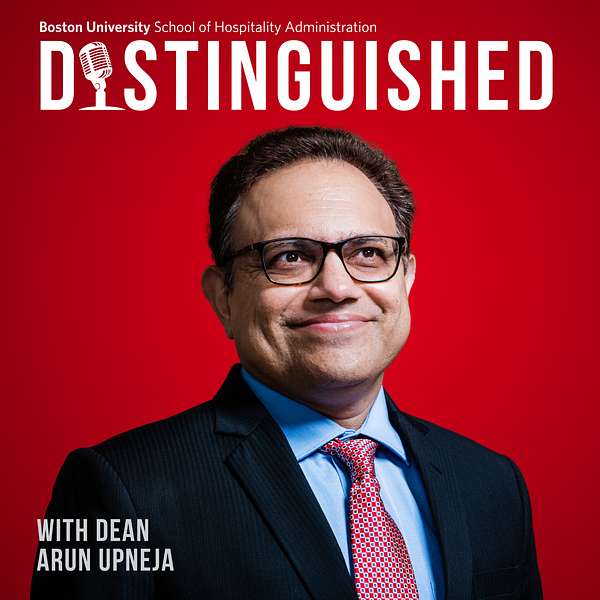
Distinguished
Welcome to the Distinguished podcast with Dean Arun Upneja of Boston University School of Hospitality Administration.
We skip the small talk and get right into the top-of-mind topics in the world of hospitality, including, but certainly not limited to, inflation, recruiting and retaining talent, the wellness and wellbeing of our team and our guests, climate action, and the impact of robotics and AI on the future of Hospitality. And that’s just to name a few.
On this show, you’ll hear from executives, general managers, founders, and investors who live and breathe Hospitality. The “distinguished” guests on this podcast represent all areas of our industry, from hotels and restaurants to entertainment and sporting venues, travel and tourism, and of course, a favorite pastime for many of us —shopping — because, to put it simply, Hospitality is at play in most parts of our lives and livelihoods.
Distinguished
Mandarin Oriental’s Legendary Luxury with James Riley, Group Chief Executive
James Riley shares how the concept of luxury stays in touch with the 21st world by creating an inclusive corporate culture and cultivating fans, many of whom are widely famous, through its world-class guest experience.
James Riley, Group Chief Executive of Mandarin Oriental
The “Distinguished” podcast is produced by Boston University School of Hospitality Administration.
Host: Arun Upneja, Dean
Producer: Mara Littman, Executive Director of Strategic Operations and Corporate Relations
Marketing: Rachel Hamlin, Senior Marketing Manager
Research: Lu Lan
Music: “Airport Lounge" Kevin MacLeod (incompetech.com)
Licensed under Creative Commons: By Attribution 4.0 License
http://creativecommons.org/licenses/by/4.0
Arun: Welcome to the Distinguished podcast produced by Boston University School of Hospitality Administration. I'm Arun Upneja, Dean of the school, and I'm pleased to welcome our guest, James Riley, Group Chief Executive of Mandarin Oriental Hotel Group. Welcome, James, to the Distinguished podcast.
James: Thank you very much, Arun.
Arun: Mandarin Oriental is synonymous with luxury and legendary service. How would you say that the concept of luxury has evolved post-pandemic?
James: I think that there was already in progress a number of changes in luxury that the pandemic in a sense has accelerated. One of these in my mind is the move away from it being business and corporately orientated towards very much more of a leisure proposition. When I look back 2014, I reckon for Mandarin, 60% of our business was probably of a corporate nature. By now, I think it's probably down to about 25%, but already by 2019, it was probably more like 40%. Increasingly, I think for genuine luxury, which tends to mean pretty high prices, corporates are asking themselves, why would we send all of our executives to stay in such expensive accommodation?
The answer tends to be that the focus is on people willing to spend for leisure and business travelers who are incorporating leisure at the same time. That's one big move that's happened. I think a second change that's occurred is the challenge from a staffing and a manning point of view, which tends to mean that luxury from a pricing point of view has to raise its prices in order to be competitive and the need therefore for there to be more of a niche luxury. The distinction between genuine luxury and hotel companies that claim to be luxury but that are in nature more volume, I think is something that's evolved further in the last three, four years. Otherwise, from a pandemic point of view, I think the other major change is that the luxury hotel companies are much more conscious of the issues to do with people being tied to operating in properties and the need to or the desire to work from home and having flexibility in working conditions has meant that people having to be very much more conscious of what the work proposition is and therefore not only is one focusing on guests but also on colleagues in terms of the work environment and what one needs to offer in order to make that attractive.
Arun: James, you've put on three very important points and let's try to unpack each one of them in turn. The first one you talked about this merging of business and leisure, that's the leisure travel trend has become much more increasingly prominent. How do genuine luxury hotels cater to this new crowd, which is they're seeking high-end luxury, they're traveling partly for business but also spending time in the hotel for leisure or perhaps their families are there as well?
James: I think the first thing is ensuring that one has the right combination of properties within the portfolio. That historically luxury, certainly for a company like ours, was quite city focused and the importance of resorts is key there. So you will find that all of the main luxury chains now have a significant portion of resorts either in their portfolio or in their pipeline of new properties coming through. And that's both about providing the opportunity, but also the impression given by the brand. I think in terms of the makeup of the product, I think larger rooms, more space is key to be able to facilitate people actually spending time in the properties and the fact that it is a more premium proposition. And then I think there's a gradual change that's going to take place in terms of public areas in terms of what people want for space to be able to utilize the properties. But there it's less clear what the evolution is and simply that people need to be thinking about what a luxury guest, whether they're for leisure or business is looking for.
Arun: So I can understand the concept of having resorts where you can somehow combine both leisure and work. But what about inner city hotels like in Boston, there is no space to increase the room size?
James: Yeah, I think it is about things like room size. I mean, in effect, those that do not have reasonable room sizes have too many rooms by nature are going to find themselves slipping down the list from a luxury point of view. So I look at it from a Mandarin perspective, our legacy hotels, particularly in Southeast Asia, were all of three, four, five hundred rooms type size. Today, whilst they preserve the positioning of luxury with our brand and the way we deliver service, the reality is those are much more volume hotels in nature. And if I look at our pipeline of 25 hotels as of today, they are all generally in the 100 to 150 room categories. And increasingly, we will have hotels where a very significant portion of the room inventory is suites.
So I do think the actual inventory needs to change. And a hotel that has three or four hundred rooms, frankly, it's going to struggle to preserve a genuine luxury positioning because the service, the standards, indeed, the uniqueness of the experience is lessened by simply the volume of rooms that's there. And the experience of staying in a room of 30 square meters is not going to be luxury. There isn't the room to turn around to turn around within the room. It's not luxury. So I think that evolution is something that's coming through. And then the rates that we're talking about, as far as luxury goes, are also increasing quite significantly. So there's a differentiator between the big volume hotel groups that would have said certain of their marks, their icons, iconic names are luxury, is beginning to split between those that are genuinely at the top end and those that actually have a much more volume orientation.
Arun: In this current climate, hiring has been a challenge. We have two big hurdles. One is that there are other sectors that pay much more tech investment banking, for example. The second is that the other sectors may also offer additional incentives and benefits, such as college tuition subsidies, flexible work week, option to work from home and other benefits that they might have. How will luxury continue to be able to hire and retain top talent?
James: I think it's a broad challenge for hospitality as a whole. There, the key is looking at the overall proposition to the colleague, the work proposition. So, remuneration and benefits are clearly very important, and ensuring that those are kept competitive within the industry at least. But it's more than just remuneration, ensuring that the work conditions are ones that are understanding of the colleagues, family circumstances, expectations are key. Being able to provide good training and learning opportunities, career progression, and ultimately, I think most important of all is providing a good, good and excellent and engaging corporate culture. And I think corporate culture is probably the most undervalued element of all the things I've spoken about in terms of when you take a job, an important thing I think is to think about how well attuned you as an individual are to the culture of the organization. Do you want to join an organization where you can be there today and gone tomorrow? Do you want to be involved in an organization where you agree with and fit with the values of that organization? And are those properly embodied and embedded in the organization? And that's where luxury, I think, can stand out. If it puts the same value on its colleagues as it does on its guests and ensure they actually are given an experience from an employment point of view, a longevity of employment, but also the overall experience, that can be a big differentiator from the financially benefit driven type opportunities of careers that people might pursue.
Arun: It's very interesting, James, when I started my career in the 1980s, early 80s, with a luxury hotel, it was very difficult for us to work 12-hour days and six and seven days a week. The kind of work environment you're describing is the exact opposite of that work culture. It's more kindler, gentler, more friendly to employees and treats them as human beings. Very interesting, big contrast between what we are used to working decades ago to what it is now.
James: Well, then let me be clear, it's aspirational, what I'm saying. It's there in certain parts of the world and certain hotels, but I have to be honest, it remains something that is an aspiration and a desire of where we want to get to. I would certainly not claim that we're already able to offer that. The change is happening. I think we're getting there, but it would certainly be true that the demands and expectations made of colleagues can sometimes be excessive, overly long hours, challenging work times and challenging work conditions. The key point, I think, is it's a prime point of focus and attention now, whereas once upon a time it was deemed to be expected of a colleague a rite of passage that one worked very long hours in very difficult conditions. And that's the change.
Arun: Right. When the chief executive of a company, of a luxury hotel company, says this is an aspirational sort of end goal for us, I think that is saying a lot. And so that is very interesting. And I'm sure that over time it will go down and into the line level. So let me talk about another trend that is very, very prevalent. And you mentioned that as the third part of your message at the very beginning, which is work from home. At luxury hotels, we are in-person and most of our work is going to be in-person. So that's the one aspect is very difficult for us to provide to our hotel employees. That sort of a key differentiator from tech and other industries, which people are able to work from home.
James: I think that's right. I mean, I think there are a couple of things. I mean, first of all, work from home is something that has evolved post the pandemic significantly. I'm not convinced the ultimate position has stabilized because I think there is still a lot that industries need to work out in terms of the modus operandi and the importance of corporate culture, which work from home makes it very difficult to perpetuate. So I think there's some evolution still to take place there. But work from home, it is an element of it. There's also that element of flexibility, and this is probably where hospitality was least good in the past. That expectation that one would work very long hours, you either took a job that was going to be 12 or 14 hours a day, or you didn't. Increasingly, being conscious of the personal positions allowing particularly mothers, others with family points to be able to do two or three days a week work preferred hours.
The same in terms of the atmosphere and the culture in kitchens, in different ways, providing the flexibility to make the work opportunity more appealing is something that's increasingly coming in. Again, I wouldn't hold out that it's the same in every part of the world, and I'm conscious I'm talking to you here in the United States, and the conditions of service that operate within Europe are somewhat different in different countries. In the Middle East can be very different, and it's important to maintain standards at the same level there and in Asia. There's enormous variation around the world, but I think it's flexibility that's most important. From a work from home point of view, it's also there are the frontline staff who, as you say, need to be in the hotels. Then there's the challenge of how much flexibility and work from home opportunity should one then give to colleagues who are not frontline, and is it right with an organization to give them the work from home opportunity when frontline colleagues don't have it?
I think it is important to provide that, but to counterbalance it by giving flexibility in terms of the hierarchical structure and employment terms for people who are working in hotels, frontline service, but having some flexibility. So in an area like housekeeping or in F&B staff, not always requiring people to be on contracts that are full time and provide some flexibility there. At the same time, also providing much better conditions at work for when people are taking breaks, trying to avoid split shifts, those sorts of elements that were always so difficult in the old work environment.
Arun: I want to pivot to diversity, equity and inclusion, DEI as we call it, and that has become increasingly more important in the United States. From the point of view of the corporate world and as a leader who represents a global company, what initiatives and actions do you think will contribute to increase diversity, especially in leadership positions?
James: I think the most important thing is conversations, discussion and openness on the topic. Inclusion is one of the most prevalent things that I find we talk about across almost all meetings. It's very much top of mind, top of conversation. Inclusion in a vast range of different types and sectors, not only in terms of race and sex, but in terms of elements of sexual inclination, but also character, personality, education, background, a whole diversity of different topics. I think the most important element is the inclusion element to make sure that the corporate culture we create is one that is inclusive of everyone. That's for me the starting point that's an absolutely no discussion.
The diversity element that then naturally follows from that is something that we talk about a lot, but it's interesting the very different perspective that comes if one's sitting in the United States where there are certain perspectives on it and the very different position that will exist in other parts of the world in terms of the challenges that exist and trying not to make comments sitting from Western Europe or the US from one perspective when actually in other parts of the world, there are some very different perspectives on what the matters of importance are. But again, being aware of diversity, encouraging it is critical. I always start though from the point of view of the thing we most want to ensure is inclusion, that we are inclusive in all respects.
And I think interestingly from a hospitality point of view, coming to some of the main topics, one of the ones that we certainly focus on to a significant extent is the gender balance within the organization. They are funnily enough; I find that hospitality is actually generally in quite a strong position. If I look through the ranks of our management, we probably fail at a very senior management point of view and directorial perspective and are conscious of getting a better balance there. But elsewhere within the organization, that 60-40-40-60 type split is very strongly in place across the organization. Where we do have to concentrate sometimes is in smaller niches in terms of departments that tend to be increasingly either very female or very male orientated, looking at it from a binary perspective and trying to work out how to make sure that one gets the balance across all departments in all areas of properties. But as you can tell from the way I'm talking about it, it's very much top of mind in a conversation that's constantly going on and therefore, I think most importantly, something that everyone's very aware of.
Arun: I want to now ask you a couple of questions about Mandarin. The business model of Mandarin is generally speaking different from many other luxury hotels. 20 out of your 33 hotels today are owned and managed by Mandarin. The other 13 are managed by Mandarin. Given that many of your competitors do not own their properties and are asset light, they only manage their properties, what are some of the advantages and disadvantages of the Mandarin model? As an example, scale. You're much smaller than many of your competitors.
James: Well, actually, I would just correct those figures if you don't mind. We own eight of our hotels, and then there are six of which we own a minority interest, i.e. 25 to 50%. So that's 14 in which we have an economic interest. And against that, we then have 22 that are managed. So the proportion that's managed is very much the dominant share of the group as the portfolio exists at the moment. But if you then look at the development portfolio properties that are under development, we have 25 hotels under development at the moment, and we don't own a dollar in any of them. So our strategy and direction is managed. And as you may have seen, a couple of months ago, we sold one of our properties that we had owned in Washington.
And the intention looking forward is increasingly not merely to only do managed in terms of new projects, but also not to be owning the hotels that we operate. So it is to move to a hotel management business rather than a property business that comprises hotels. The origins of the group were in ownership of properties in Southeast Asia that were operated as hotels. It's built from that into a very powerful global brand. And now I think is the right moment to say we don't need to own properties in order to be able to win management contracts. And in that context, we're therefore very much focusing on managing properties, not owning them. Having said that, we have a substantial amount of the balance sheet still tied up in ownership. So for the time being, it's very important. And that's really a characteristic of certain Asian hotel groups that have tended to have a property component as well as the hotel management component. So I think it's natural for us to be focusing on management. And I wouldn't be advocating property involvement other than for those who want to have a significant part of their net worth tied up in properties.
Arun: Would you consider having non-third-party management companies manage Mandarin, or do you insist on every single Mandarin flagged hotel being managed by the Mandarin?
James: Yes, I would absolutely insist on that because we're a management company and the key asset that we have other than our colleagues is the value of the brand. And if you're going to manage your brand and manage it effectively, I think it's critically that it's under your direct control. So I also wouldn't contemplate a franchise type structure because at that point, one's effectively divesting one's ability to control the quality that one's offering. And if you lose control of that, then I think you lose the ability to deliver quality.
Arun: What do you want consumers to know about Mandarin? Why should they stay at your hotel?
James: I think ultimately one wants them to appreciate and understand what luxury is about. It's about service first and foremost. We talk about the remarkable design and style. We talk about the food and beverage positioning and the Michelin stars and the high-quality cuisine. We talk about the incredible spa and wellness facilities, all of which are very relevant. But the most important thing in terms of what Mandarin can deliver and the experience one goes away from a Mandarin having stayed is service. And that is at the heart, in my view, of luxury. So delivering service is key. And more specifically, I think, from a Mandarin point of view is empathetic service, a service that is styled and developed to meet the aspiration and expectation of the specific guest.
So that rather than having colleagues that are operating from a script where they say all the right lines to tick off in terms of quality standards from a third party point of view, they're actually engaging with the guests in a way the guests expect. I give you a specific example. Some people come and stay at a luxury hotel and wish to have people bowing and scraping and treating them very formally. Others, and I'm one of those, hate that and prefer to have a relaxed style. So when I go to the hotels, I expect people to call me James. I hate being called Mr. Riley. It takes quite a lot of time to get colleagues to be adjusting to recognize that some people want the formality of service delivery and others want a more relaxed style and therefore engaging and focusing on that. So people are thinking when they deliver service rather than simply delivering a script is key. Again, it's aspirational. I certainly wouldn't claim that every colleague in Mandarin gets that, but that's the aspiration and I think aspiration is central to delivery of a service standard.
Arun: James, for a little fun, we wrap up this edition with this speed round of questions to learn more about you. So if you could have dinner with anyone from any era, past or present, who would it be and why?
James: The person I found most impressive and I'm not going back into distant history, but in my lifetime would have been Lee Kuan Yew, who was, I think, an inspirational leader, the creator of a remarkable country who was willing to ignore all political correctness and standard protocol to do what he believed was right. And I think his achievement in building up a city state from what was in effect a malarial swamp when the British were operating it into an incredible modern metropolis and his own personal stamp in doing it without self-aggrandizement or creating personal wealth is quite remarkable. I found many of his comments that he made ones that one would shudder at first sight but recognized the intelligence of on reflection.
Arun: What book do you find yourself recommending to friends, family or colleagues most often?
James: My favorite book and I read avidly, very diversely, is Les Miserables, which is a very long time to get one's way through. It's about 1200 pages by Victor Hugo set in the 1830s in Paris. And whilst in itself being a wonderful tale, if one has the patience to read it all, it also has incredible insight into the political, social and economic challenges of the time. Many or most of which are just as relevant as they are today in terms of the suppression of the underprivileged, the poor, the inequalities of law for different people in society. And I think he provides, Victor Hugo provides a remarkable insight in a very entertaining and engaging way. So that as a novel is probably the book I find most compelling to recommend.
Arun: What type of music do you like?
James: I listen to lots of music, but the honest answer is listeners won't be aware. I can't see very much. I've largely lost my sight now, and therefore I do and listen to almost everything audio wise. And therefore the ability to listen to music and listen to books, podcasts, etc. is tough. So actually I don't listen to very much music. I'm constantly focusing on audible material, spoken material, books, podcasts, news, and the like.
Arun: So the last question here. As the chairman of the Royal Geographical Society Hong Kong branch, what part of the world is attracting your attention right now?
James: Well, being based in Hong Kong, inevitably, we do spend quite a lot of time focusing on travel within greater China. But at the same time, when people are going out and exploring and traveling, and I've been very fortunate over the last 20 years or so to have had many of the world's great explorers and travelers to stay or to speak at the society, inevitably it's the more extreme parts of the world that get the most attention. So it tends to be Antarctica, the North Pole, the Himalayas, the high mountain passes that get the attention. And in particular, I think it is the Antarctic that gets most attention, both because of the fact that it still remains a relatively unexplored wilderness, but also because of the consequences of global climate change, the degree to which it provides indications of how things are moving, the degree to which ice shelves are melting, breaking away, the changes that are occurring within the ocean that are indicative of changes happening in our world today.
Arun: Thank you, James, for visiting our school all the way from Hong Kong. It's been a pleasure to talk to you.
James: Thank you very much, Arun. I've enjoyed it.
Arun: And thank you, everyone, for joining us today. Special thanks to the team who produces this podcast, Mara Littman, Andy Hallock, and the entire team at Boston University School of Hospitality Administration. To keep up with Distinguished podcasts, be sure to subscribe wherever you listen to your favorite podcast. You can also learn more about our undergraduate and graduate programs at Boston University School of Hospitality Administration by visiting bu.edu/hospitality.
