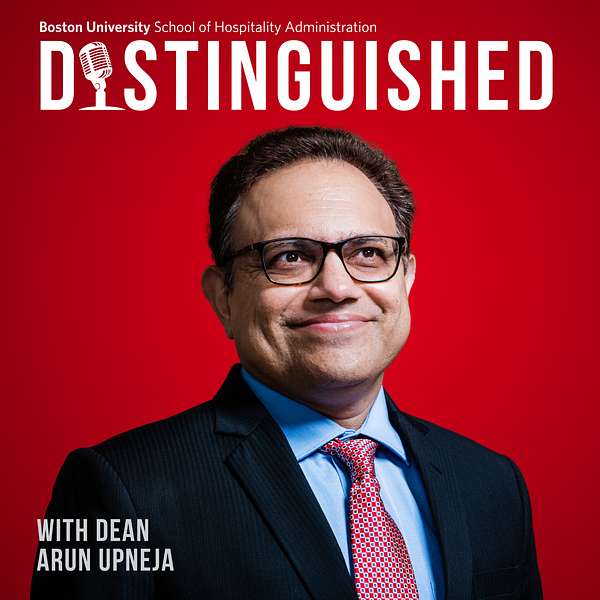
Distinguished
Welcome to the Distinguished podcast with Dean Arun Upneja of Boston University School of Hospitality Administration.
We skip the small talk and get right into the top-of-mind topics in the world of hospitality, including, but certainly not limited to, inflation, recruiting and retaining talent, the wellness and wellbeing of our team and our guests, climate action, and the impact of robotics and AI on the future of Hospitality. And that’s just to name a few.
On this show, you’ll hear from executives, general managers, founders, and investors who live and breathe Hospitality. The “distinguished” guests on this podcast represent all areas of our industry, from hotels and restaurants to entertainment and sporting venues, travel and tourism, and of course, a favorite pastime for many of us —shopping — because, to put it simply, Hospitality is at play in most parts of our lives and livelihoods.
Distinguished
Meet Boston: Widening the View with Hilina Ajakaiye, Executive Vice President of Meet Boston, and Colette Phillips, CEO and President/Chief Strategist/Visionary of Colette Phillips Communications, Inc.
Meet Boston (formerly Greater Boston Convention & Visitors Bureau) introduces a new way to experience Boston. The “All Inclusive Boston” and “Boston never gets old” campaigns widen the lens to present the city’s diverse and inclusive angles while keeping the city’s rich history as part of the picture. Hilina Ajakaiye, Executive Vice President of Meet Boston, and Colette Phillips, CEO and President/Chief Strategist/Visionary of Colette Phillips Communications, Inc., have been instrumental in the rebranding of the Greater Boston region to showcase an ever-evolving Boston.
Colette Phillips, CEO and President/Chief Strategist/Visionary, Colette Phillips Communications, Inc.
Hilina Ajakaiye, Executive Vice President, Meet Boston
Boston Campaigns:
All Inclusive Boston
Boston Never Gets Old
The “Distinguished” podcast is produced by Boston University School of Hospitality Administration.
Host: Arun Upneja, Dean
Producer: Mara Littman, Executive Director of Strategic Operations and Corporate Relations
Marketing: Rachel Hamlin, Senior Marketing Manager
Research: Lu Lan
Music: “Airport Lounge" Kevin MacLeod (incompetech.com)
Licensed under Creative Commons: By Attribution 4.0 License
http://creativecommons.org/licenses/by/4.0
Arun: Welcome to the Distinguished Podcast, produced by Boston University School of Hospitality Administration. I'm Arun Upneja, Dean of the school, and I'm pleased to welcome our guests, Hilina Ajakaiye, Executive Vice President of Greater Boston Convention and Visitors Bureau, and Colette Phillips, CEO and President, Chief Strategist, Visionary of Colette Phillips Communications, Inc. Welcome to SHA.
Hilina: Thank you.
Colette: Thank you.
Arun: In their roles, Hilina and Colette have been instrumental in the rebranding of the Greater Boston region. In this podcast, we're going to talk about their roles in this rebrand, and what the changes say about us, the people of Boston, and the city, which is both historic and modern all at once. This change is monumental because it symbolizes a new way to view Boston by focusing on diversity and inclusivity, while keeping the city's rich history as part of the picture. So let's start by each of you telling a bit about yourselves. How were you each involved in these efforts? I'm going to start with Hilina.
You started at what was formerly known as GBCVB, and now Meet Boston at the start of the pandemic. So tell us about how in your new role, you went about repositioning Meet Boston's role in Greater Boston alongside President and CEO Martha Sheridan and the Board of Directors.
Hilina: Thank you so much, Dean. It's a pleasure to be here. And I think as I think about hearing you say the Greater Boston Convention & Visitors Bureau, and now fast forward two weeks young into launching what we know to be Meet Boston, it's an exciting time to be. As you said, I joined the organization in 2020 at the heels of the pandemic and social unrest. And we had an opportunity, and we continue to have these opportunities to tell a different and a more authentic story about the city of Boston, the people that live in it, and the fact that we have 23 neighborhoods in an incredible Greater Boston and Massachusetts surrounding. So in our role in telling the broader story, you are part of our rebrand committee.
We thought about how we tell the authentic story of the people that live in the city of Boston, a majority minority city, and we have been partnering with some incredible people throughout the city, including the leadership in the mayor's office, Colette Phillips Communications, who is here with me, and Proverb Agency to talk about how do we do this. And we have taken that momentum of telling an inclusive story, and now we have rebranded so that we become that organic kind of momentum of yes, the old Boston, but there's a lot of new things happening here. We want to tell you about it, and we want you to experience it with us.
Arun: That's fantastic. That was an amazing process. I really enjoyed it. So thank you for getting me involved in the process of that rebrand. So Colette, you've earned multiple descriptors, Cultural Change Catalyst, DEI Pioneer, Innovator, Serial Entrepreneur, and the list goes on of your contributions and achievements. In addition to your position as President and CEO of Colette Phillips Communications, you are the founder of Get Connected. I'm interested to learn more about Get Connected and how the organization increases discourse, builds partnerships, and catalyzes innovation.
Colette: Thank you, Dean. I am delighted to be here and to tell you more about Get Connected. Get Connected was founded 15 years ago. It's hard for me to even comprehend that it's been 15 years since I basically founded Get Connected. The purpose and the mission of Get Connected is really about cross-cultural interactions, networking, business and career connections. I found that Boston has been a city that operated in silos. You have people of different cultural backgrounds, but only within their respective communities. And I wanted to create a place, a venue, where people of all cultural backgrounds could come together, could get to know each other, can build relationships that in itself would become opportunities. Because at the end of the day, people do business with people they know, people they like, people they trust, and people they feel have value to add to them.
And the only way that's going to happen, it's not going to happen on LinkedIn, it's not going to happen on Facebook, and I love social media, but it's going to happen when people connect with each other in an authentic way face to face. So that was really the purpose of creating Get Connected. And as a result, I was able to get several corporations, like Eastern Bank, like Liberty Mutual, State Street, Blue Cross and Blue Shield, Dell, to really come to the table to support Get Connected as a place where they could send their employees and to also act as a platform that could be a retention platform because we were losing a lot of professionals of color who didn't think they felt welcomed in Boston.
And that really is the story behind Get Connected. And it continues to be a place that basically celebrates, amplify, elevate and bring people together to break barriers down, build bridges and break down barriers. So I'm very proud of Get Connected and the fact that after 15 years, it continues to be such a major factor with regards to diversity, equity and inclusion in the city of Boston.
Arun: Colette, that's amazing. And I'm sure you were very excited when you were included in this All-Inclusive campaign that the city is doing. So can you tell us how did you sort of get connected to the campaign? How did the campaign even begin? And what were the ideas and inspiration for it?
Colette: That is amazing. I love that you use get connected. Well, I will tell you in 2019, I had sent a letter to the mayor of Boston because I came to Boston as a 17-year-old over 40 years ago to go to college. And I kind of got really tired of hearing about Boston not being this welcoming city, Boston being racist, Boston, all the negative things. And the Boston that I know, I wanted to begin to help others to see that Boston. Boston is a city that has 140 languages spoken here. Two in four Bostonian describe themselves as culturally diverse. One in four, three of us sitting here are all immigrants. So one in four is foreign born.
And I felt there was a story to be told. And I sent this email to the mayor, whom I knew personally, Mayor Marty Walsh. And then the pandemic came the following year, and there were funding from the federal government around how do we create a new and inclusive view of the hospitality industry in Boston? How do we reopen in a way that was safe and use the opportunity to really change Boston's image? So I invited Meet Boston and Proverb Agency to join me, Colette Phillips Communications, to apply to this RFP. And so we were, I think, a very dynamic team because we had the same goals.
We came to this with the same lenses and worked brilliantly together throughout the pandemic, never meeting in person. So we worked literally through Zoom and through emails from October of 2020 until April of 2021 when we actually launched the campaign. And as I said earlier in a class here at BU, research drives innovation, research drives a marketing campaign. That if you don't know your audience and you don't know how people perceive you, you really don't know how to create the right kind of campaign. We all had a sense of what Boston's image was, but we needed to really hear others tell us that. And so we used the research that Meet Boston did and used that as the jumping-off point to create this absolutely unbelievable award-winning, all-inclusive Boston campaign, one that I think we are all very proud of.
Arun: It is an incredible campaign. And thank you for sharing that. I am going to pursue a little bit further. You've been here 40 years, and this city has had a reputation for being unfriendly to people of color and minorities. Have you seen a change in the last 40 years? Or is this just putting lipstick on and trying to sell a city that is not the same as before? Or it is the same?
Colette: I will tell you that Boston has changed. When I was a student here, and even 25 years ago, I would not have gone to certain parts of Boston because I wouldn't feel comfortable or welcomed. Today, I could go into any and every neighborhood, the 23 neighborhoods in Boston, without even blinking my eyes. When I was a student here in Boston 40 years ago, I would not have gone to Charlestown. Today, my office is in Charlestown. Today, one of my closest friends lives in South Boston, a place that I would not have gone 25, 30 years ago. And the North End, I was just there last fall for several of their festivals. And I love Italian food. So Boston is not the Boston of 30, 40 years ago. And again, you have so many. We have become almost a culinary global, you know, ecosystem. You have great Indian food, great Ethiopian food, great Caribbean food. You know, we represent a global culinary ecosystem, second to none in this country. So Boston truly has changed. 140 different languages are spoken in this city. And look, we now have the first ever mayor of Asian American Pacific Islander background. And in the last year, we have had two mayors of color, a black mayor who was appointed and an Asian mayor who was elected. So that in itself tells you how Boston has changed.
Arun: Absolutely. And you know, this fact that you're mentioning the mayors, in some way it is, you know, a huge, big change. And I'm very happy and proud to sort of doubt this fact. Well, the other hand, this is 2023. I mean, if it had not happened so far, when would it? I mean, it's just amazing. So you also talked about the 23 different neighborhoods. And I'm going to explore that with Hilina also. But you know, it's just surprising that most people, they have a very limited understanding of what Boston is.
So, Hilina, from a hospitality perspective, Boston Never Gets Old campaign, especially resonated with all of us, those who love Boston. And from the perspective of hospitality, particularly since we are focused large part on the creation and promotion of memorable experiences in the area of travel, tourism and leisure. So can you sort of lay out the process? What led to this rebranding process? Who was involved in creating this campaign? Just talk about the process.
Hilina: Yeah, and the process, Dean, as you know, you were intimately involved. And I think that what we knew would be critical to this process is making sure that we have a perspective from different sectors of the city of Boston. We knew that academia was important. We knew that the arts were important. We knew that sports were important. And we knew that culinary and our restaurants and all of the collective lens of how we see the city of Boston was critical to be at the table. We started this journey of wanting to change our name tactically from the Greater Boston Convention & Visitors Bureau to Meet Boston and really playing on that exact thing of, hey, listen, you may think you know Boston, but really meet Boston. And so when we sat down, I believe we had over 24 committee members that you are on to sit down and listen to agencies that would help us re-articulate who Boston really is. And we had about 24 RFPs come in.
We went down to 14, we went down to 8, we went down to 4, and then we went down to 1. And really the task was how do you take that momentum when we think about that momentum and call to action of changing the perception. So we know that Greater Boston is fueled by a collective spirit of transformation. It's a city built by motion and designed to stay in motion. So we're constantly evolving. But we needed to make sure that in that evolution we had guiding principles. And what are those guiding principles? And that's really what we did with the agency on record, is that we needed to really think about how to tell the story of the city of Boston, both domestically and internationally. Some of the guiding principles that I think have really given us some guardrails to think about is inclusiveness, reflecting more inclusive and authentic version of Boston.
There are 23 neighborhoods here. There are all these languages and people from all over the world. We have 2.5 million international visitors that come here every year. We have to tell them that there's inclusion here. We also want to make sure that we're newsworthy in a good way. We talked about during the All-Inclusive campaign that people have perceptions of Boston that are not true, whether it's too racist, that you're not welcomed, that it's all white guys in caps drinking beer. That may be a perception you have or Goodwill Hunting and Dunkin Donuts, but we wanted to make sure we were newsworthy. We want to highlight Boston through the lens of the unexpected and the expected. So residents, tell the people who Boston is about.
In addition to that, we talked about, you asked Colette earlier an important question, has there been change in the last 40 years? I would venture to say I've been here in the city of Boston since 1987. There absolutely has been because of the work of incredible partners like the city and Colette and now Meet Boston taking this. So that idea that we're constantly in motion, Boston is an ever evolving experience that's always in season. So there's always something going on here and we want to highlight that. And then the pillars kind of want to make sure also that we don't kind of, there's no erasure of history, right? Our history is who we are. So historically we want to celebrate Boston as a history maker, an invention or an innovator of the past, present and the future. So there's this kind of idea that we need to ditch the past in order to get to the future. It's really making sure that there's a balance of acknowledging who we were, who we want to be and where we're going. So we want to make sure that we do that with the guiding principles. And then the last couple that I'll mention to you is, you know, transportive, you know, challenging people to go beyond the known, experience the culture.
We talk about not staying in the south or not staying in the seaport. We want people to go to Roxbury. We want people to go to Dorchester, East Boston, and experience the 23 and a half neighborhoods in the city of Boston. And be proud of that. That's our last guiding principle. Be proud of all of the different things and embrace the unique Boston that we all know. The soul of the expectations and the explorations is critical to how we mark a Boston. So as a destination marketing organization, those guiding principles, really the ricochet of what All Inclusive has started, still continues to, I think, vibrate through the city of Boston. So we'll kind of integrate it in everything that we do.
Arun: Thank you for that incredible description. I think there is a whole lot to unpack. But I just want to go back to the process a little bit. So you mentioned 24 people who were involved in this. Of course, I was there, part of it. But how did you get all of them to line up and support this incredible initiative in terms of the campaign, in terms of the focus, in terms of what kinds of language we're going to put out? How did you accomplish out of that?
Hilina: Well, I think that everyone at the table loves Boston from a different vantage point. But at the end of it all, we all loved it for what it is. So whether it was academia or whether it was music and nightlife or art or hoteliers that were at the table, they were restaurant owners. At the end of the day, for us to be able to re-articulate the story is that we couldn't do it without the perspective of what was important to a wide range of audiences. So I know you were in the room. And I'll kind of, with a level of confidentiality, we had some tough conversations in that room about what should be the campaign, what should be the voice, what should be that kind of balance of rethinking the brand. And how do we tell an agency on record to articulate that? You know, we, for example, had Ed Kane from Big Night Life at the table. What's important to him is nightlife, right?
It's all to drive visitation. It's all to give that kind of interesting perspective in what visitors would look for and what residents would look for. But we also had folks that were in the room that were restaurant owners like Nia Grace. You know, we had Catherine Morris from BAMS Fest. And we also had, you know, folks that are restaurant owners. You know, we had hoteliers in there. We just had a great hotel open in the seaport called Omni. And his vantage point of why the seaport is important was completely different. So, I think that the process was definitely representative of the different stakeholders in the city of Boston. But the call to action was how do we come up with a good story for the city that we love. And everyone had that in common.
Arun: You mentioned that you launched, officially launched it two weeks ago. So, what has the feedback been since you have launched it two weeks ago?
Hilina: Yeah, the feedback has been incredible. I think that a lot of consumers, both internal to the city of Boston and really residents, it starts with the pride of the residents. The feedback has been, okay, we feel and we see that there's a momentum to do something different. And that you're exposing a part of Boston that's inclusive, that wider lens of really looking at everyone that is a part of this story. One thing that we have done in the last, I would say, three years is really partner with incredible people that are within the neighborhoods that are real people. So when we went to launch our campaign and our brand in New York a couple of weeks ago, we brought some critical stakeholders with us to the biggest stage in launching a brand, which is New York City.
And we had folks that were in the arts and culinary and talking about the same Boston. We had, you know, MRE. Jeffers from Embrace Boston talking about that incredible momentous installation of the first monument on the oldest park. We had, you know, Douglas Formida. We had Tiffany Faison. We had proteges of Rob Black doing live murals of what they felt like Boston's new momentum is. I don't like to say the new Boston. I feel like we're always uncovering the Boston that a lot of folks have always worked hard to uncover, that joy of that we're all here and we're all creating a history that is positive. So that's what we've been doing and the feedback has been incredible. People want to come to Boston and that's the goal of this rebrand and this campaign is that we want to drive visitation to the city of Boston.
Arun: Excellent. Now that brings me to the next question, which I'm going to ask Colette in a moment. But let me ask you, how do you measure the success of this campaign?
Hilina: That's a good question. We ask ourselves that question, I believe, a dozen times a day. I think that visitor sentiment is a real thing. I think that resident sentiment is a real thing. I consider this more of a marathon and not a sprint. So if I could tell you from a marketing perspective, from a personal perspective, success would look like that folks would come to the city of Boston and feel like they belong and that they really activate the economic opportunity of all of the neighborhoods.
So we'll continue to use our social channels to do some sentiment and listening. And we've talked about net promoter scores are likely to recommend or amputee engines from a marketing perspective. But success would look like that we stay authentic to telling a consistent story and that we continue to partner with folks internally and externally to the city of Boston. So more to come on what success would look like. But success is, you know, I think having folks like you, myself, Colette who live in the city and, you know, experience joy and that are diverse and that are here making a great life for ourselves both professionally and personally.
Arun: Excellent. Okay, so Colette, how do you measure the success of the campaign All Inclusive Boston?
Colette: Well, I think that Hilina said it beautifully when she said this is a marathon and not a sprint. I think the impact of how you measure it is how the people who live here in Boston begin to show up and feel about Boston, that we can tell the Boston story with pride and also seeing who is coming to Boston. I think pre-pandemic, Boston attracted lots of people of color that came through Boston. They went to the Cape. They went to the Vineyard. They went up to New Hampshire. But they weren't specifically coming to Boston. Now, with this new campaign, we will see people coming to Boston. They become our Goodwill Ambassadors, if you will.
And I think that the intersection of the All-Inclusive Campaign and Meet Boston is brilliant because what it does is that it is saying to people, maybe you don't know Boston the way we know Boston. So we basically are introducing you, as Hilina said, not to the old Boston or to the new Boston, but to the Boston that is continually evolving. Boston is a place where revolution took place, and I feel in a lot of ways we are always consistently in that motion of revolution. Revolution and innovation and motion. So we are changing all the time. We're a very dynamic city. And I think to me the impact is being able to go down to the seaport and seeing people of all backgrounds going into Roxbury, into the Nubian Square, and being able to sit in an Indian restaurant there and see people of all cultural backgrounds having a meal and connecting with each other. That to me is the power of the impact, how we measure that and to see that people now become the ambassadors for Boston because they feel it and see it and it's real.
Hilina: I just love one thing that, you know, many things that Colette said, but one thing that is a true measure of how we continue to kind of amplify this momentum is how residents show up in their own city. You know, I often say people want to go where they feel welcomed. You know, we have, you know, so many opportunities to amplify the fact that folks don't need to come through Boston and go to Martha's Vineyard every summer. And I love that, how residents show up on a daily basis, 365 days of the year, people are watching. So we need to work from the inside out and get the folks that are outside to come in by the joy that we kind of exude. And I can't wait to do that.
Arun: Yeah, there's so many different themes. I really enjoy it. Boston is a city of revolution, innovation, and it's perpetually in motion. You know, obviously I'm biased, but the fact that there's so many universities here, world-class faculty doing incredible research, and all the young people that are here studying, that kind of brings vitality to Boston that's very difficult to find in other cities. So when I'm listening to the both of you talk, you're hitting on so many similar themes of diversity and inclusion, and this Boston that is perpetually changing, and it is friendly, and it is inclusive in all these neighborhoods. But yet we do have these two distinct campaigns, one from the city of Boston, one from Meet Boston. Do you, and this is for both of you, do you see any synergies between the campaigns? Are they connected? Do they have the same underlying concepts, or are they focused on different constituencies, and hence they have different, they speak different languages?
Colette: I would say that the intersectionality of those two campaigns is definitely synergistic, simply because they build on each other. The All-Inclusive campaign really is giving you a message that people probably don't know that Boston has all of these culturally diverse people of immigrant background that lives in the city. We are a center of innovation and academia and technology and life sciences. So we are constantly attracting people from all over the world, which makes us a center of innovation and diversity. So there is that aspect. And then on the Meet Boston, Meet Boston is literally building on the All-Inclusive Boston. And even though the Meet Boston might be focused on some ways externally to bring more conventions, bring more visitors, bring more meetings to Boston, we want when people come here that they experience the Boston that you and I and Hilina and Bostonians experience. So they get to experience Boston like there is a travel group that says, live like a local. So we want our visitors when they come here to feel like a local.
Like, wow, I didn't know this about Boston. So that's why I think these two campaigns intersect because they're also built on research. Research drives creativity, innovation, when it comes to a marketing campaign. So I think that that, to me, is the strong foundation and pillar that helps to make these campaigns blend.
Hilina: I couldn't agree more. I think that the power of intersectionality, the power of running parallel tracks, and also connectedness, right? While you think about the momentum, you know, as a destination marketing organization, we are on this momentum. And really, it takes everyone to beat the same drum or to play their part in this chorus, in this choir that we are, if I dare use an analogy. We all need to be in this choir striving to play the same song. You know, everyone during the pandemic, I think, really, really had the pressure of looking at equity, diversity, and inclusion in every sector, making sure that people felt a sense of belonging. I'll use my good friends, our good friends, who I absolutely respect and I'm passionate about the work we do, MBC 10 News. They just rebranded. And guess what their tagline is? News worthy of you. Everyone wants to be highlighted in a good way. Everyone wants to be spoken in a good way.
So I think that when you think about the campaign that the Red Sox Foundation did, where, you know, there was definitely a re- kind of, surgence of looking at sports in the city, specifically, you know, baseball. So I think that I see everyone as part of this incredible choir. And so there's no, you do it, start, stop, I'll take the baton and run. We're all running in the same direction. So we're all part of this choir. Everyone needs to play their part. We're not going to start and stop anything. We're going to keep building together. We'll keep going back to each other for some advice. But there certainly isn't like, I do it by myself. And we're grateful that this started, you know, three years ago with the All-Inclusive campaign. But that momentum is palpable. We're all doing it in different sectors, but definitely in this industry.
Arun: And this again is for both of you. For many years, Boston marketing was focused on Faneuil Hall, the Freedom Trail, Beacon Hill, USS Constitution and other similar historic landmarks. It seems that with the current repositioning of Boston, it's more about the neighborhoods and the diversity of people and experiences that one can discover in Boston. So for each of you, how would you describe Boston today to someone who is visiting our city?
Hilina: I mean, I'll kind of parlay a little bit from the neighborhoods' angle is that, you know, I think I would describe Boston as a place where there's something for everyone. There truly is. And Colette talked about it earlier. You know, the amount of languages and people that are here, the fact that it's a majority minority city, you know, I will tell you that our narration of where to go, what to do has changed. You know, the visitor center on the common pre-pandemic, we would see about 1.6 million people come to us domestically and internationally, and they'll say, hey, Colette, where should I go? What restaurant should I go to? What neighborhood should I experience? And post, I think, our campaign, post the pandemic, post all of this incredible work that we're doing around inclusion and neighborhoods, we're telling people to go to different neighborhoods. You know, I'm not just saying go check out Faneuil Hall. I'm telling them to go to Park 54, to go to Zazz, to go to, you know, Darrell's Corner Bar and Kitchen. So I think it's also wayfinding. It's also making sure that from a staff perspective, you know, we're making sure that we're cognizant of how to be a wayfinder, how to be that gateway to the feeder market, the neighborhoods.
We also have a visitor center on wheels. You know, that was one thing that we knew that a lot of this visitor information could not get to the corners of our neighborhoods. So now we have a visitor center on wheels. The same thing that we do at the Brickham Mortar on the Common, we do within this large scale. And we're getting into neighborhoods because knowledge is power. This is the third largest economic development engine. And so every business, every human, every culture should be a part of that choir. They should play a part. And so I think it's an exciting time from that perspective. I would tell people, don't blink, don't miss it. There's a lot of joy, a lot of fun happening in the city of Boston, not to mention all the things you talked about around education and academia and the best life sciences and health centers.
Arun: How about you? How would you describe Boston?
Colette: I would say it's not an either or. It's just more of a broader path to choose from, if you will. And you can go to Faneuil Hall and you could go to Castle Island in South Boston. You can go to Nubian Square or JP. You can have great seafoods at one of the traditional seafood restaurants, but you can also have great seafood at one of the local restaurants in Boston, local ethnic restaurants. Yeah, like Pearl, which we love. Or Flames, which is Caribbean, or Blue Niles, Ethiopian restaurant. So I would say that imitation is the best form of flattery. And we had a reporter here from England who said the reason why she came to Boston and contacted me wanting to do a story was because London is very much like Boston.
You have all the old traditional, you know, the castles and the this and the that and all the same things that Boston had. But London has also changed, and it's changed because of the diversity, the Asian population, the Caribbean population. And they wanted to come here to see how Boston was doing with its All-Inclusive Campaign. And can this campaign be something that they could take back to London to say, we don't need to change and tell people, don't go visit Buckingham Palace. You know, we can still, you can still visit Buckingham Palace. But you know what? You can also go into the West End and you can go into the areas where there is great Indian food and great Caribbean food and experience London as a global ecosystem. And I thought, wow, the fact that she was here to learn from us is in itself, what should I say, evidence that the campaign is already successful.
Arun: All Londoners are welcome to Boston. So a question to each of you. What do you love about Boston? And tell us about your favorite place to go hang out for some time, as long as you don't mention Faneuil Hall or Freedom Trail or one of those regular, which all of us know about. So what do you love about Boston and a favorite place to visit and hang out?
Hilina: Yeah, I mean, I'll bring it back to kind of, I think, when I first came here in 1987 as a 12-year-old girl who didn't know English and my solace was, you know, sitting on the Charles River and watching BU students and students rowing. It gave me peace. It was simple. It didn't cost me any money. And I still find myself going back to kind of that space of just sitting on the lawn and just looking at students. I am, you know, I came here to go to school, so the academic environment really excites me. And, you know, that's where I go to kind of think and to kind of read and to be with the nature. You know, we talked about earlier that we have water spaces here. And for those folks who love water, you can sit by the Charles River and do a lot of reading, a lot of reflecting. So that's my solace. I do it now with my 12-year-old and 16-year-old. But, you know, I'll leave it there. There are too many places for me to choose one, but I'll stick with that one.
Arun: I love that. Right by the Charles River, next to the BU Beach, next to Boston University. Amazing place to sit and relax. Thank you for that. And Colette, how about you?
Colette: Well, for me, I have to say what I love most about Boston is the ethnic cuisine. I mean, I actually have created an annual event called A Taste of Ethnic Boston because we want to celebrate the diversity in the culinary ecosystem and introduce it to people. When I think of Boston and the food that's my favorite, the ethnic food that's my favorite, I think of the late Anthony Bodane. There is no better way to learn about culture than through people's food because the food tells you a lot. You can learn from the food. And the other thing that I like about Boston is Boston is a really strong music town. I love going to the Explanard and just having all this free music where you can pack a picnic basket, you can go with a bunch of friends, and you can sit and listen to great music, everything from pop and jazz to classical music, or participate in BAMFest, which is a music festival that gives you an exposure to world music. And again, it comes back to all-inclusive. And that's what I love about Boston. The Boston I love is all-inclusive in its food, in its music, in its people. And that's my Boston.
Arun: Fantastic. On behalf of everyone at the School of Hospitality, all the faculty, staff, students, and our amazing producer, Mara Littman, I thank you for coming and spending so much time at this school and for recording this podcast.
And thank you everyone for joining us today. Special thanks to the team who produces this podcast, Mara Littman, Andy Hallock, and the entire team at Boston University School of Hospitality Administration. To keep up with Distinguished podcasts, be sure to subscribe wherever you listen to your favorite podcast. You can also learn more about our undergraduate and graduate programs at Boston University School of Hospitality Administration by visiting bu.edu/hospitality. Thank you.
